Navigating the Path of Knowledge: Matric vs Intermediate in Pakistan’s Education Landscape
Explore the intricate tapestry of Pakistan's educational stages as we dissect Matric and Intermediate.
Written By
Kh. Muhavia
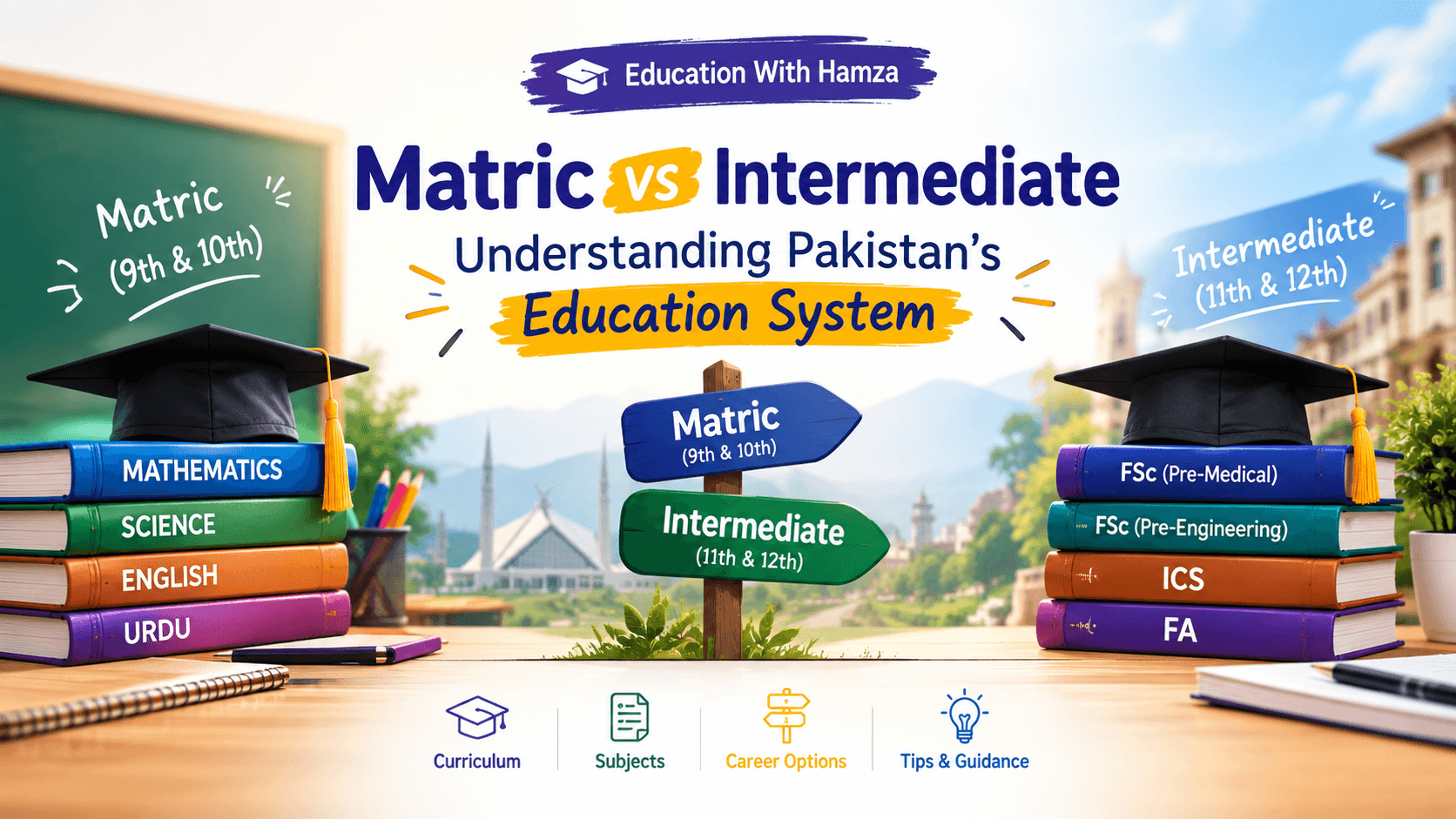
Pakistan’s education system is a multifaceted entity that shapes the lives and futures of millions of students. Among its key milestones are the Matric and Intermediate stages, each playing a crucial role in a student's academic journey.
In this article, we will explore the characteristics, significance, curriculum, and key differences between Matric and Intermediate education in Pakistan. Understanding these two stages can help students and parents make better academic decisions.
Understanding Matriculation
Matriculation, commonly known as Matric, is the secondary education stage completed through Grades 9 and 10 in Pakistan. It leads to the Secondary School Certificate (SSC) and provides students with the academic foundation they need before moving into higher secondary education.
Students studying at this level generally follow a broad curriculum that develops their understanding of core academic subjects while also helping them identify their interests and future areas of study.
Structure of the Matric Curriculum
Depending on the board, group, and educational stream, Matric students may study subjects such as:
- Mathematics
- Physics
- Chemistry
- Biology
- English
- Urdu
- Islamiyat
- Pakistan Studies
- Computer Science and other elective subjects
Students generally choose an appropriate group or combination of subjects according to their interests, abilities, and future career plans. Their performance is assessed through examinations conducted by the relevant educational board.
Quick Tip: Strong performance in Matric can provide students with a solid academic foundation for Intermediate studies and future university programs.
Significance of Matriculation
Matric is an important milestone because it prepares students for the next stage of their education. Some of its major benefits include:
- Gateway to Higher Education: Matric qualification allows students to apply for Intermediate and other higher-secondary programs.
- Academic Foundation: It develops fundamental knowledge and study skills needed for more advanced subjects.
- Career Awareness: Students begin to identify their academic strengths and possible career directions.
- Board Examination Experience: Students become familiar with formal board examinations, assessment patterns, and examination preparation.
Students looking for additional preparation material can explore EWH 9th Class Resources and EWH 10th Class Resources for notes, study material, and examination resources.
Understanding Intermediate Education
After completing Matric, students can move to Intermediate education, which generally covers Grades 11 and 12. This stage is commonly known as higher secondary education and leads to the Higher Secondary School Certificate (HSSC).
Unlike Matric, Intermediate education is more specialized. Students select a group based on their academic interests and intended career path. Common options include Pre-Medical, Pre-Engineering, Computer Science, Commerce, and Humanities.
Structure of the Intermediate Curriculum
The exact subjects depend on the selected group and educational board. Common subjects and areas of study include:
- Advanced Mathematics
- Physics
- Chemistry
- Biology
- Computer Science
- English
- Urdu
- Economics
- Accounting and Commerce-related subjects
- Humanities and Social Science subjects
Intermediate examinations are conducted through the relevant educational boards. Students' results at this stage can play an important role in determining their eligibility and merit for university degree programs.
Important: Intermediate is generally more specialized and academically demanding than Matric because students begin studying subjects that are closely connected to their intended fields of higher education.
Significance of Intermediate Education
- University Admission: HSSC or equivalent qualifications are commonly required for admission to undergraduate degree programs.
- Career Orientation: Specialized groups allow students to focus on subjects related to their intended careers.
- Advanced Learning: Students develop deeper conceptual understanding, analytical skills, and problem-solving abilities.
- Preparation for Higher Education: Intermediate helps students transition from school-level learning to university-level academic expectations.
Students preparing for Intermediate can explore EWH 1st Year Resources and EWH 2nd Year Resources for notes, study material, and examination preparation.
Key Differences: Matric vs Intermediate
Although both Matric and Intermediate are important stages of Pakistan's education system, they differ in their academic level, specialization, and purpose.
| Factor | Matric | Intermediate |
|---|---|---|
| Grades | 9th & 10th | 11th & 12th |
| Certificate | SSC | HSSC |
| Curriculum | Broad and foundational | More specialized and advanced |
| Main Purpose | Builds secondary-level academic foundations | Prepares students for higher education and career pathways |
| Specialization | Comparatively broad | More focused according to selected group |
Preparing for Matric and Intermediate Exams
Success at both levels requires consistent preparation rather than relying only on last-minute study. Students should understand their syllabus, practice questions regularly, revise important concepts, and become familiar with board examination patterns.
Using quality notes and past papers can also help students identify important topics and understand how questions are presented in board examinations.
For additional preparation, students can visit the EWH Notes Library and explore Past & Model Papers for additional study resources.
Conclusion
Understanding the distinction between Matric and Intermediate is important for students and parents navigating Pakistan's education system. Matric builds the academic foundation, while Intermediate allows students to specialize and prepare for higher education.
Both stages have their own challenges and opportunities. Students who develop consistent study habits, understand their subjects, and make informed academic choices can build a stronger foundation for university and their future careers.
Whether you are preparing for Matric or Intermediate, Education With Hamza provides free educational resources, notes, past papers, schemes, and other study materials to help Pakistani students prepare more effectively.
Explore Education Resources
Looking for notes, past papers, paper schemes, and other resources for your board exams? Explore the free resources available at Education With Hamza.
Explore EWH ResourcesReader Reviews (0)
No reviews left for this article yet.
Be the first to share your thoughts below